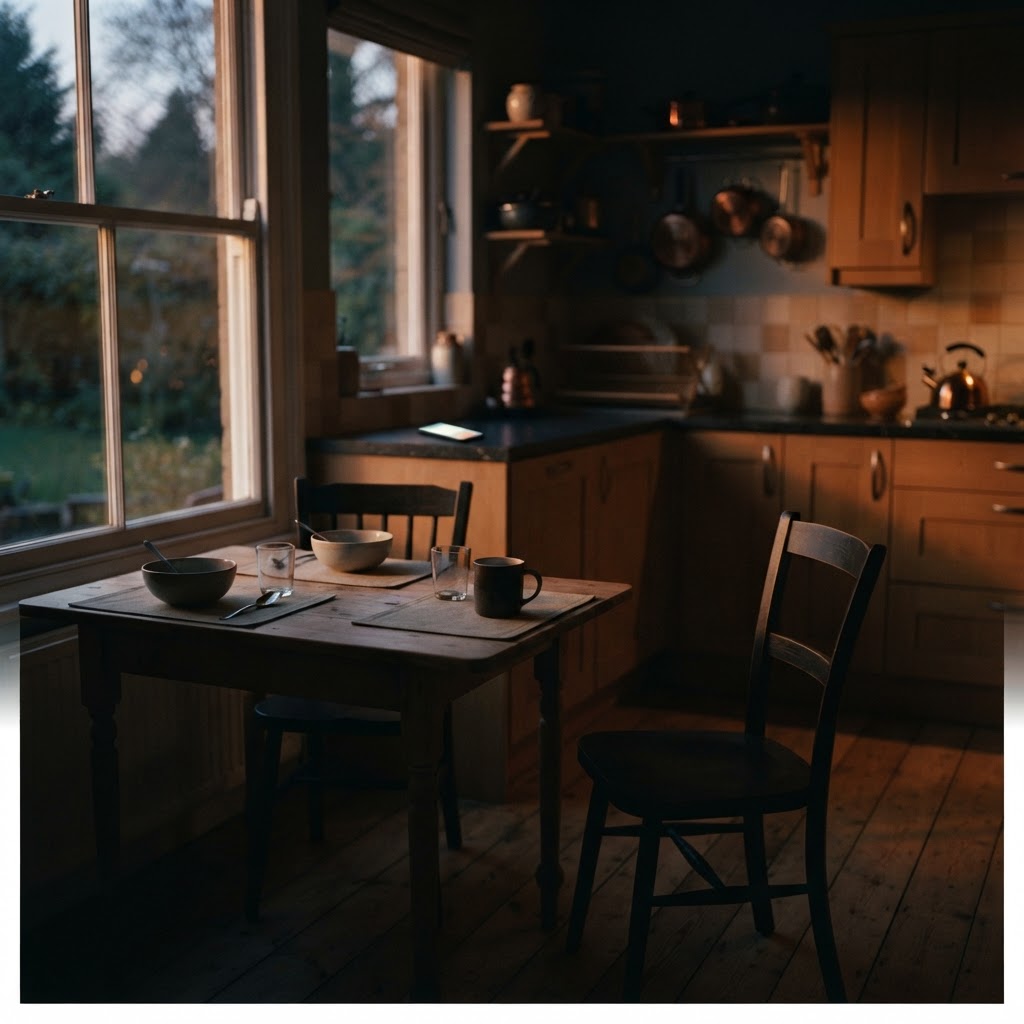
What It Cost: The Far Side of a Dime
A few months after It Doesn't Cost a Dime went out into the world, a reader wrote to me. He said he had read the whole thing in one sitting and that it was the kindest book anyone had ever handed him. Then he said the sentence I have not been able to put down since.
I already knew every one of these. I just stopped doing them.
That is the book I had not written. What It Cost is that book.
The same hundred moments
Dime is built on a simple idea: the things that keep a marriage alive are small, they are free, and they are mostly a matter of noticing. The hug at the door. The phone face-down at dinner. The hand reached for in the car. A hundred chapters, a hundred moments, each one closing with a single line for tonight.
What It Cost keeps every one of those chapters. Same numbers. Same moments. Same house.
But it stands on the far side of them. Chapter 12 in Dime is the hug that happens at the door. Chapter 12 in What It Cost is the hug that stopped. Not with a fight. Not with a decision. It just stopped, the way things do, and neither of them can tell you the week it happened.
Each chapter is a short scene in the present tense, from inside one marriage going quiet. Each one closes with the sentence he didn't say, in italics, and why it stayed in. And then a plain accounting, one or two sentences, of what that silence cost.
Why the husband's side
I wrote the whole book from the husband's side, and I did that on purpose.
Not because husbands are the problem. Because I am one, and I know that voice from the inside: the reasons that sound like reasons, the tiredness that becomes a habit, the way a man can be in a room and not be in it. I could write that honestly. I could not write her side honestly, and I was not willing to pretend.
So there is a rule the book never breaks. No chapter names her, blames her, or explains her. She is there in every scene, but the camera never turns on her to make a point. This is not a scorecard. It is a mirror, and a mirror only shows you the person standing in front of it.
What it actually costs
The hardest part of writing this was refusing to make it dramatic.
Nobody in these hundred chapters throws a plate. Nobody has an affair. Nobody leaves. What happens instead is quieter and, I think, far more common: the phone that never goes down. The hand that isn't reached for. The silence that lasts three days and is never mentioned again. The dinner eaten in the same room and separate worlds.
And the cost of each one is small. That is the point. A hug that stops at the door costs almost nothing. It is the ninety-ninth one that costs a marriage, and by then nobody remembers the first.
The center of the book, the thing every chapter circles back to, is this: a marriage where one person has stopped noticing does not just go cold. It stops running. And the house waits for whoever is still carrying it.
Where the way back is
You will not find the way back in this book. I left it out deliberately.
It is in the other one. Same chapter number.
That is how the two books are meant to be read: side by side, or one after the other, or with a thumb in each. If Chapter 40 of What It Cost is the one that lands in your chest, Chapter 40 of Dime is what you do tonight. There is a route page near the front called Where It Hurts that points you to the chapters that match the quiet in your own house, so you do not have to read all hundred to find yours.
I wrote Dime for the couples who wanted to hold on to something good. I wrote What It Cost for the man who already knows every one of those hundred things and, somewhere along the way, stopped doing them.
If that is you, this book is not here to tell you what you did wrong. It is here to show you what it cost, and then to hand you the other book.
What It Cost: 100 Ways a Marriage Goes Quiet is coming September 2026. The companion to It Doesn't Cost a Dime.