Below the Shelf
A Novel
by David Bishop
They thought they found rocks. They were right about the finding. They were wrong about the rocks.
The Story
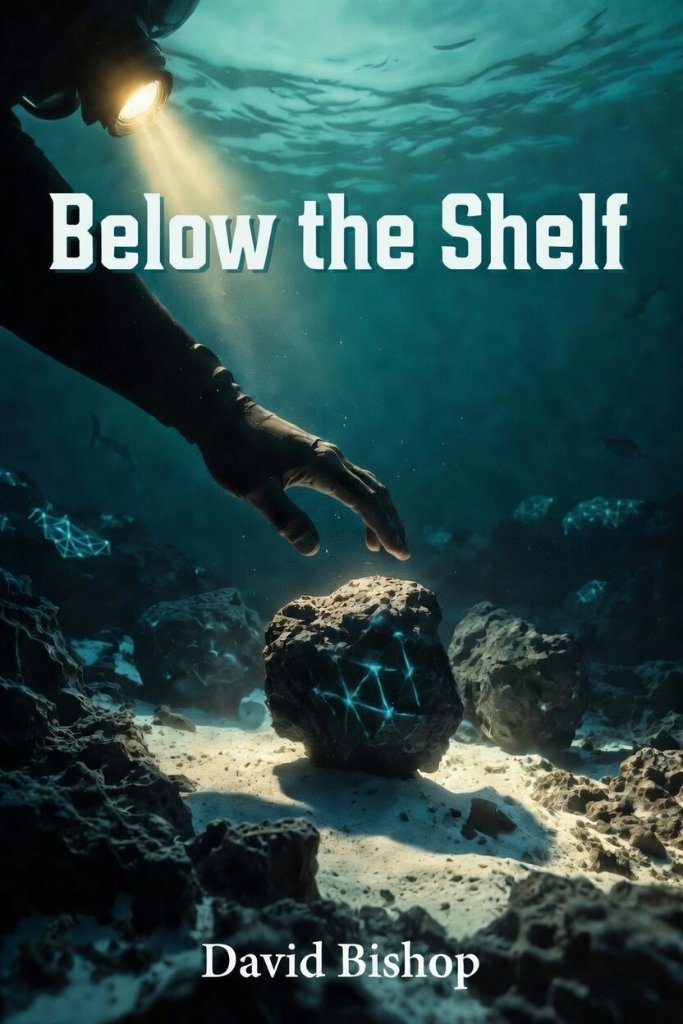
Maya Reyes has been diving the Gulf Coast shelf for ten years. She knows what belongs down there. The cluster of objects her group brings up from 90 feet, on a Tuesday morning in June, does not belong anywhere. Within 72 hours, four people are changed in ways they cannot explain. Their senses are sharper. They need less sleep. They think faster. They feel better than they have in years. They do not know they are compromised. Within a week, the Navy knows. The site has been classified for fourteen months. The objects have been monitored. What was not anticipated was someone picking one up. Within a month, the mutation is diverging. For most, it stabilizes. For Maya's brother Tommy, it does not stop. And what Tommy is becoming is not a disease — it is something older than disease, something patient enough to wait 40,000 years on the ocean floor for a species capable of carrying it home. Below the Shelf is a techno-thriller about a first contact event that does not announce itself — it seeps in, through the skin, through the lungs, through the blood-brain barrier, until what was left behind is inside every person who was ever in the wrong place at the right time. Set on the Florida Gulf Coast, grounded in real marine biology and neuroscience, and built on the terrifying question of what we would sacrifice to keep becoming better than we are.
Book Structure
The Discovery
Chapters 1–10 (~25,000 words). The novel opens on the dive. Maya leads a four-person charter to the Panhandle shelf at 90 feet and discovers the formation. The first physical effects — improved night vision, vivid dreams, reduced sleep — are pleasant enough that no one flags them as alarming. Act One ends with the Navy's notification and Tommy's first anomalous blood test.
The Unraveling
Chapters 11–25 (~50,000 words). The Crichton engine. The system fails in layers. The second dive discovers a structure too regular to be geological. The mutation diverges across the four exposed individuals. Tommy's escalation provides the horror spine — each chapter slightly more wrong than the last. Ends with the federal quarantine declaration and Caleb's disappearance.
The Reckoning
Chapters 26–35 (~30,000 words). Two simultaneous timelines: Maya racing to reach Tommy before the Navy's containment protocol reaches its final stage, and Caleb alone at 90 feet doing something to the formation. The climax is a decision scene, not a fight scene. The resolution is deliberately ambiguous. The objects are not destroyed. The mutation is not cured.
Characters
Maya Reyes
Protagonist
Age 34. Dive instructor and owner of a small charter operation out of Fort Walton Beach, Florida. Former Navy diver. She is the first person to bring an object to the surface — holding it for forty seconds during the ascent. Everything that happens to her body over the following thirty days traces back to those forty seconds.
Dr. Caleb Horowicz
Secondary Lead
Age 41. Marine biologist, University of West Florida. The science voice of the novel. The character most tempted by the mutation — his cognitive enhancement manifests earlier and more dramatically. He is writing papers in his sleep. He does not want it to stop.
Tommy Reyes
Mutation Outlier
Age 22. Maya's younger brother and deckhand on her charter. In the 8-to-12 percent whose mutation does not stabilize. By chapter thirty, he is no longer reading as fully human on standard medical tests. He is the reminder of what the objects are actually capable of.
Commander Diane Vogt
Institutional Antagonist
Age 49. Naval Intelligence, attached to NAS Pensacola. Not a villain — a problem-solver who solves this problem the wrong way. She was briefed on the shelf formation fourteen months before the novel begins and represents the failure mode of institutional thinking when confronted with something it cannot classify.
Sheriff Louise 'Lou' Pratt
The Investigator
Age 52. Okaloosa County Sheriff, 24 years in office. The Grisham voice embodied. She does not understand the science. She understands jurisdiction, and she understands that two of her county's residents are being held without charges in a Navy facility and nobody will tell her why.
Key Features
Crichton / Grisham Voice
Michael Crichton's plausible scientific premise followed to its terrifying logical conclusion, supported by John Grisham's procedural tension and character grounding. Short chapters. Propulsive pacing. Real geography.
Grounded Science
The mutation vector, myelin sheath modification, nanostructure self-assembly, panspermia theory, and deep-sea thermal preservation are all anchored in real science stretched exactly one step to its fictional limit.
The Seductive Horror
The infected characters do not become monsters. They become something better than human — and that is the terror. The mutation is seductive before it is lethal. The reader, like the characters, is not sure whether to fight it or surrender to it.
35 Chapters, 3 Acts
The Discovery (Ch. 1–10), The Unraveling (Ch. 11–25), and The Reckoning (Ch. 26–35). Three interlocking POVs converging under the pressure of a 40,000-year-old countdown no one knew had started.
Major Themes
What It Means to Be Human
The mutation does not make the characters less human in the ways they fear. It makes them more capable. The question the novel asks is whether humanity is defined by its limitations — and what it means to voluntarily surrender those limitations.
The Failure of Institutions
The government does not save anyone in this novel. Not because the government is evil, but because the government is a system designed for categories, and what is happening does not fit any existing category. The institutional failure is systemic, not personal, which makes it more honest and more frightening.
Loyalty in Extremity
Every major character faces a loyalty test in Act Three. None of these tests have clean answers. The novel provides characters who make choices and live with the weight of them.
The Long Game
Whatever left the objects behind was not thinking in human time. 40,000 years is nothing to a civilization capable of seeding a planet with engineered nanostructures and waiting for the results. The horror is not the mutation. The horror is the patience.
Book Details
Author
David Bishop
Category
Techno-Thriller
Chapters
35
Words
105,000