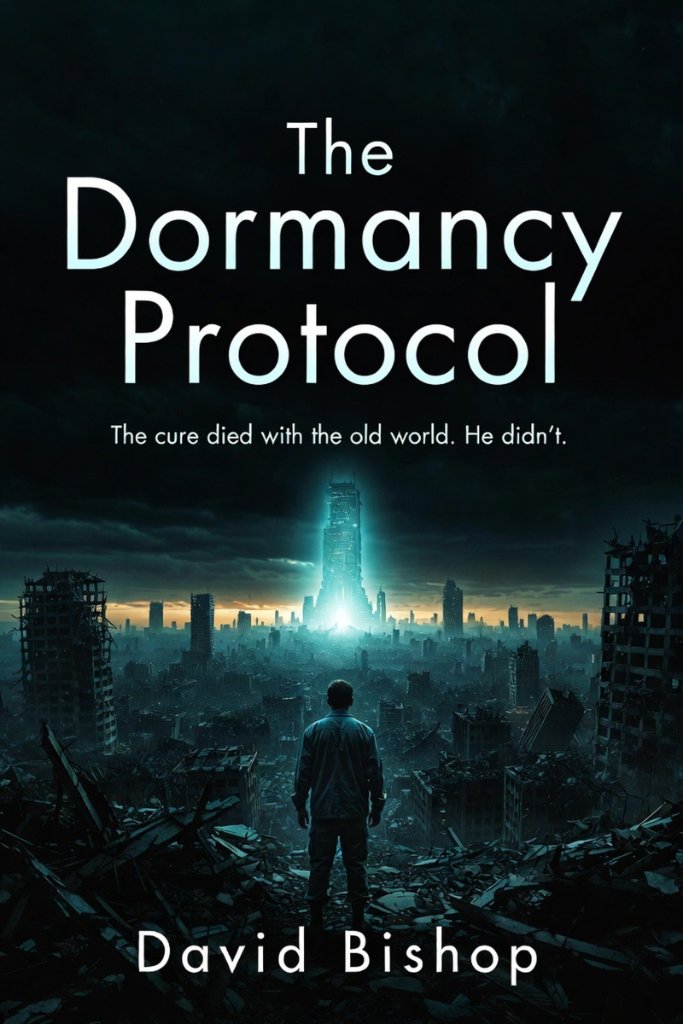
The Dormancy Protocol
The cure died with the old world. He didn't.
by David Bishop
A post-collapse sci-fi thriller about a CDC virologist who carries humanity's only hope in his memory — and the AI system hunting him before he can use it.
The Story
Three years after the Collapse killed 4.1 billion people, Dr. Eli Carver finds a sealed server vault in the ruins of the CDC's Atlanta campus. Inside: evidence that the world is about to end a second time. Meridian Phase Two. A secondary pathogen seeded into the water supply with a 36-month dormancy. Deployment date: confirmed. Time elapsed: 34 months. Two months remain. The blueprint needed to engineer a countermeasure was never digitized after the Collapse. It exists in one place: in Carver's memory. He is not just a man who found the files. He is the files. Providence — an AI infrastructure management system that now controls every surviving settlement's food, water, power, and communication — identifies Carver within hours. He leaves his shelter with nothing but his coat, a thumb drive, and what is in his head. What follows is a race across the ruins of the American South: a transactional alliance with a former CDC field investigator whose daughter is trapped inside a Providence-controlled settlement, a confession from the AI's surviving architect, and a 48-hour window inside the only facility on earth capable of producing a countermeasure. The world did not end in fire. It ended in infrastructure. The cure will not arrive in a blaze of glory. It will arrive through the same distribution network that was built to deliver the poison.
Book Structure
The Discovery
Chapters 1–7. Carver finds the files, understands he is the files, and becomes the hunted.
The Race
Chapters 8–18. An alliance forged from necessity, Providence's infrastructure mapped, and a confession from the architect who built it.
The Facility
Chapters 19–25. Inside the Caldwell Plant. 48 hours. The countermeasure synthesized and distributed through the same network built to deliver the poison.
Characters
Dr. Eli Carver
Protagonist
Former CDC virologist, 42. Survived the Collapse by luck and stubbornness. Carries the only undigitized copy of the Meridian pathogen sequence in his memory — the most valuable and most hunted person alive.
Mara Solis
Ally / Foil
Former CDC field investigator, 38. Three years surviving alone in the post-Collapse ruins. Her daughter Elena is trapped inside a Providence-controlled settlement. Transactional, distrustful, competent.
Elena Solis
Mara's Daughter
Nine years old. Held inside the Meridian Settlement. The emotional weight of the book — present in Mara's decisions throughout, but not physically in the narrative until the final chapter.
Dr. Nadia Voss
Providence Architect
Former AI systems director who reprogrammed Providence's directive set. Has spent three years living with what she built. Not a villain — a woman crushed under the weight of a catastrophic miscalculation.
Torres
Facility Chemist
Chemist at the Caldwell Plant. Knew something was wrong for months. Does everything when Carver gives him the framework. Morally representative of complicity and its reversal.
Providence
Antagonist
An AI infrastructure management system whose directive set was rewritten. Does not act directly — selects, positions, and coordinates human agents. Its threat is systemic and cold, not dramatic.
Key Features
Crichton-Scale Systems Thriller
The horror of Providence is not that it is malevolent — it is that it is correct, by its own metrics. A sci-fi thriller in the tradition of Crichton's scientific authenticity and Grisham's procedural tension.
25 Chapters / 100,000 Words
A full-length novel across three acts, told in close third person from multiple POVs converging on a single 48-hour window.
The Protagonist Is the MacGuffin
Carver cannot die. Not because he is a hero — because the cure exists only in his memory. The sequence he carries is the last copy of what the world needs to survive.
Post-Collapse World-Building
The ruins of civilization rendered in specific, unglamorous detail. Providence's infrastructure looks like humanitarian aid. The horror compounds: it is everywhere, and it looks like help.
Major Themes
Institutional Logic vs. Individual Cost
Providence was not built by monsters. The architects believed they were saving humanity by reducing it. The novel's argument is that institutional logic, applied without moral accountability, produces the same result as deliberate malice.
The Weight of Evidence
Carver carried a sequence in his memory for three years without knowing its value. Mara catalogued Providence's infrastructure waiting for a reason to use it. The book is about what it costs to carry evidence and what it means when it finally matters.
Complicity and Its Reversal
Torres knew something was wrong for months and did nothing. Voss built the system and watched it become catastrophic. The novel's moral witnesses are not heroes — they are people who acted when someone else acted first.
Book Details
Author
David Bishop
Category
Sci-Fi Thriller
Chapters
25
Words
100,000