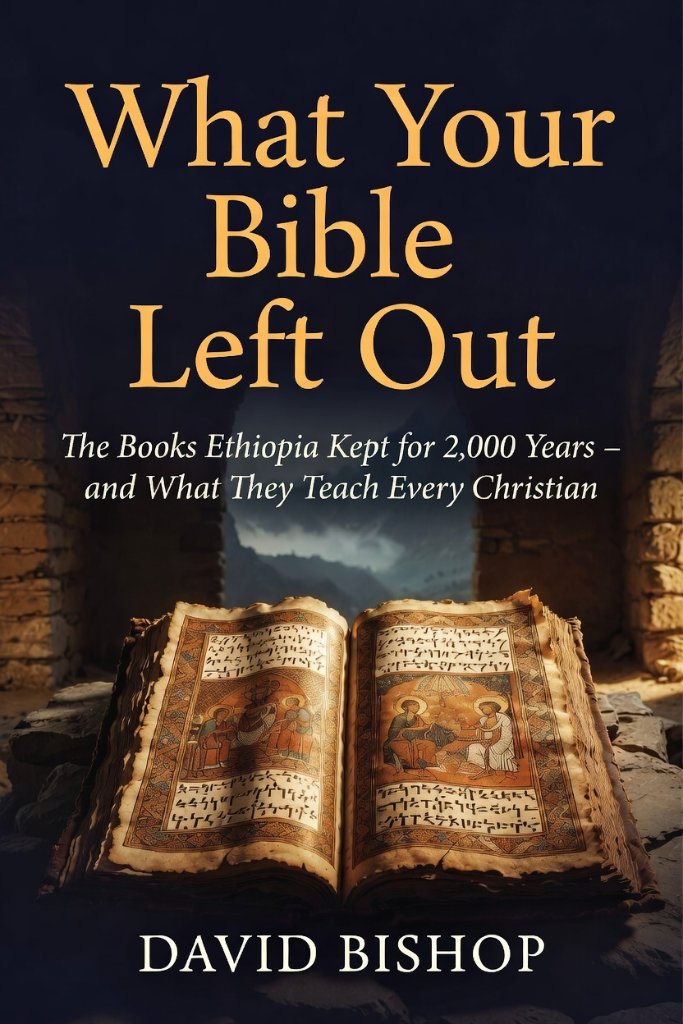
What Your Bible Left Out
The Books Ethiopia Kept for 2,000 Years - and What They Teach Every Christian
by David Bishop
Somewhere in Ethiopia, on a mountaintop 7,000 feet in the air, is the oldest illustrated Christian Bible on earth. It has 81 books. Yours has 66. This book opens that library — no Greek, no Hebrew, no seminary required.
The Story
Somewhere in Ethiopia, on a mountaintop 7,000 feet in the air, there is a monastery. Inside it is the oldest illustrated Christian Bible on earth. It has 81 books. Yours has 66. For 2,000 years, the Ethiopian Orthodox Church has been reading 15 texts that most Protestant Christians have never heard of — texts that the New Testament quotes directly, that fill the 400 silent years between Malachi and Matthew, and that developed the resurrection theology Paul builds on in 1 Corinthians 15. This book opens that library. No Greek. No Hebrew. No seminary. Just the full library — finally opened. 112,984 words. 25 chapters. 5 parts. Foreword through Epilogue plus 5 appendices including a complete four-way canon comparison, a timeline from Second Temple to Reformation, and biographical profiles of Luther, Origen, Jerome, Athanasius, Calvin, Josephus, and Bonhoeffer.
Book Structure
The World's Oldest Bible
Chapters 1–4 — Historical and canonical context. The Ethiopian Orthodox Church, the Garima Gospels, the canon debates, and the Bible the Reformation never touched.
Books Unique to Ethiopia
Chapters 5–11 — Texts found in no other Christian canon: 1 Enoch, 2–3 Enoch, Jubilees, 1–3 Meqabyan, 4 Baruch, Josippon, and Messale/Tagsas.
Deuterocanonical Books
Chapters 12–18 — In Ethiopian and Catholic Bibles but not Protestant: Tobit, Judith, Wisdom of Solomon, Sirach, Baruch, 1–2 Esdras, and Prayer of Manasseh.
The New Testament Additions
Chapters 19–22 — Church-order books unique to the Ethiopian New Testament: Sinodos, Didascalia, Books of the Covenant, and Ethiopic Clement.
What We Lost and Can Recover
Chapters 23–25 — The holes in Protestant theology, the documented NT connections to these texts, and a practical reading guide for the general reader.
Key Features
No Seminary Required
Written in plain English for the general Christian reader. Voice: Steve Jobs + Billy Graham. Warm, direct, pastoral.
112,984 Words, 25 Chapters
Full-length Christian nonfiction with Foreword, Introduction, 5 Parts, Epilogue, and 5 Appendices including a complete four-way canon comparison.
Every Claim Sourced
The NT connections to these texts are documented scholarship from every tradition — not speculation. A complete connection table is included in Chapter 24.
12-Month Reading Plan
Chapter 25 includes a practical guide to reading all 15 books with reliable translations, starting points, and a pacing plan for readers without an academic background.
Major Themes
The 400 Silent Years
Josippon fills the gap between Malachi and Matthew — Alexander, the Maccabees, the origin of the Pharisees and Sadducees, and the world Jesus walked into.
What the New Testament Was Reading
Jude quotes 1 Enoch by name. Paul's 'third heaven' requires 2 Enoch. Romans 1–2 is built on the Wisdom of Solomon. James quotes Sirach throughout. These connections are documented, not speculative.
The Canon Debates
Who decided what goes in the Bible, when, and why — from the Septuagint to the Council of Carthage to Martin Luther's Reformation decisions and their lasting consequences.
What Protestant Christianity Lost
Six specific theological gaps — the origin of evil, pre-Christ resurrection theology, corporate confession, church governance, practical ethics, and the intertestamental world.
Book Details
Author
David Bishop
Category
Biblical History
Chapters
25
Words
112,984