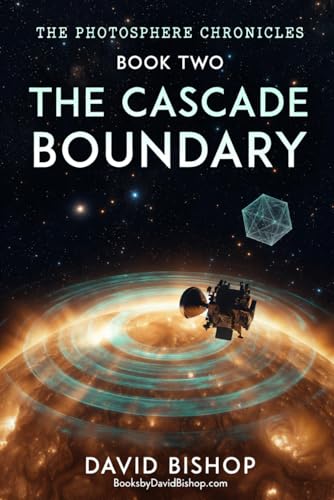
The Cascade Boundary
The pulse was not a greeting. It was an alert.
by David Bishop
Six years after the Helio-7 breach, Commander Vasquez returns to 0.31 AU aboard Helio-8 to read the embedded second layer of the Day 211 pulse — and discovers the 13 degraded stellar systems are not random. Something is moving through the local stellar neighborhood, and the sun has been trying to warn them.
The Story
Six years after Day 211, Elena Vasquez has spent every one of them building the case for Helio-8. The mission is not Helio-7 repeated. The stakes are different. The instruments are different. And what Vasquez is going back to do is not observe — it is to read. Yusuf Okafor has been running a quiet analysis for three years before he is confident enough to show her: the 13 stellar systems showing active coherence degradation are not a random distribution of natural failures. The decay curves are structurally identical. The failure mode is the same. Something caused these 13 systems to fail at roughly the same time. Miriam Holt, at 74, has found something no one else caught. The Day 211 pulse was not broadcast. It was aimed. At the Helio-7 sensor array. By something that has been watching for six years to see if the receiver would return. It is waiting for Helio-8. What Vasquez and her crew find at 0.31 AU rewrites the mission's purpose: the 14 degraded systems form the leading edge of something propagating through the local stellar neighborhood. The sun survived because it was in a gap. The others were not. And the pulse — now recurring, now counting — is telling them exactly how many coherent states remain above the threshold required to send it. The count will go to 40. Then 39. The question the pulse is asking is not whether they can help. It is whether they will be in position when it matters.
Book Structure
The Return
Chapters 1–9 (~30,000 words). Six years later. Helio-8 is weeks from launch. Okafor brings Vasquez the common cause failure finding. The mission that was already urgent becomes critical. Act One ends when Helio-8 launches.
The Signal
Chapters 10–21 (~42,000 words). Helio-8 in transit and on station. The receiver array comes online. The Day 211 pulse second layer begins to resolve. The 13-system finding goes public. The second layer is something that requires a decision.
The Answer
Chapters 22–30 (~28,000 words). Vasquez makes the decision. The book ends with a new state more complex than the state at its open. What they learn establishes what would be required. An unresolved beat that is the correct setup for Book 3.
Characters
Commander Elena Vasquez
Protagonist / Mission Commander, Helio-8
Age 53. Six years older, professionally unassailable, personally narrowed to the mission. She commands Helio-8 and must step outside the engineering frame that served her in Book 1.
Dr. Yusuf Okafor
Lead Scientist, Helio-8
Age 45. He found the common cause failure pattern. He is no longer the man who wanted to discover alien life. He is the man who understands what the discovery means — and experiences the urgency of 13 failing systems as a calling.
Dr. Miriam Holt
Theoretical Foundation, Earth
Age 74. Her primary emission process theoretical treatment — the seventh process — is the intellectual engine of Book 2. She identified that the Day 211 pulse was directional, not broadcast. It was aimed.
Dr. Kenji Saito
Quantum Signal Architect, Helio-8 Crew
Age 38. He designed the Helio-8 receiver array — four years building a receiver for a signal he has never heard. He thinks in fault trees, like Vasquez. They disagree sharply about what to do when the second layer resolves.
Dr. Fatima Al-Rashid
Mission Science Director, Ground
Age 50. The most institutionally powerful scientific coordinator in the world on this question. She manages the 13-system finding's political implications on Earth while Vasquez manages them from 0.31 AU.
Admiral Chen Li
Strategic Peer
Age 57. Her quantum signal analysis team is now the best in the world for this problem. She identifies the first external data point suggesting the 13 systems' failures are not random. She brings it to Vasquez. No politics. Just data.
Maya Vasquez
The Human Cost Made Specific
Age 30. Senior infrastructure architect, managing the European consortium's adaptation to the permanent reallocation framework — working inside the operational consequences of her mother's decision, every day, for six years.
Major Themes
Common Cause Failure at Interstellar Scale
When multiple independent systems fail in the same failure mode within a narrow time window, the probability of independent random causation is vanishingly small. The 13 systems are exhibiting common cause failure. Something caused them.
The Ask
The pulse is not an alert about an immediate threat. It is a handoff. They are asking humanity to be there when the next one fails — to become the kind of civilization that can.
The Boundary
The 14 degraded systems form the leading edge of something moving through the local stellar neighborhood. The sun is inside the boundary. Not on the leading edge — inside. It survived. The others did not.
What the Others Knew
Some of the 14 failing systems had biological civilizations that detected an anomaly before the hard failure. They did not know what they were looking at. The universe does not guarantee the conditions for response. It distributes them.
Book Details
Author
David Bishop
Category
Sci-Fi Thriller
Chapters
30
Words
100,000
Series
Book 2